Financial planning is one of the most important disciplines in personal finance - yet it remains one of the least understood. At its core, financial planning is the process of defining financial goals, assessing current resources, and building a structured strategy to achieve those goals over time. It is not a single event but an ongoing, adaptive process that evolves with your circumstances.

For Everyone
Planning at Every Life Stage
Whether you are just beginning your career, raising a family, approaching retirement, or managing significant wealth, a financial plan provides the clarity and discipline needed to make sound decisions.
Understanding Financial Planning
In Simple Terms
Financial Planning
Financial planning is the process of working out where you are financially, deciding where you want to be, and creating a plan to get there.
The CFP Board defines financial planning as “a collaborative process that helps maximise a client’s potential for meeting life goals through financial advice that integrates relevant elements of the client’s personal and financial circumstances.”
This definition captures two essential ideas:

Collaborative - Financial planning works best with professional guidance
Holistic - It considers the full picture, not just investments
Key Distinction
More Than Managing Money
Financial planning differs from simply managing money. Budgeting, saving, and investing are all components of financial planning - but the discipline brings them together into a coherent, goal-driven strategy. It answers the fundamental questions: What do I want to achieve? What resources do I have? What is the best path forward?

Global Standards
Planning for Every Income Level
Importantly, financial planning is not only for the wealthy. The Financial Planning Standards Board (FPSB) - which oversees financial planning standards across 27 territories - emphasises that financial planning is relevant to individuals at every stage of life and income level. Whether the goal is building an emergency fund or structuring a multi-generational estate, the process applies equally.
The financial planning process follows a structured methodology recognised globally by the CFP Board and the FPSB. While the number of steps may vary slightly depending on the framework, the core logic is consistent.
01
Understand Your Current Situation
The process begins with a thorough assessment of your financial position: income, expenses, assets, liabilities, insurance, tax situation, and existing commitments. This creates a factual baseline from which all decisions flow.
02
Define Your Goals
What do you want to achieve? Goals may include retirement at a specific age, funding education, purchasing property, building an emergency reserve, or leaving a legacy. Each goal is defined in terms of priority, time horizon, and financial requirement.
03
Analyse the Gap
With a clear picture of where you are and where you want to be, the next step is identifying the gap. This analysis considers whether current strategies are on track and what adjustments may be needed.
04
Develop Recommendations
Based on the analysis, a set of recommendations is developed. These may include changes to savings rates, investment allocation, insurance coverage, tax strategy, or debt management. Each recommendation is evaluated for feasibility and alignment with your goals.
05
Implement the Plan
Recommendations become actions. This may involve opening accounts, adjusting portfolios, purchasing insurance, restructuring debt, or establishing trusts. Implementation requires discipline and, often, coordination with other professionals.
06
Monitor and Adjust
Financial planning is not static. Life changes - career shifts, family events, market conditions, regulatory changes - require the plan to be reviewed and adjusted regularly. Most professionals recommend a comprehensive review at least annually.
Key Insight
According to the CFP Board’s 2024 Financial Planning Longitudinal Study, individuals who work with a financial planner report greater confidence in achieving their financial goals and higher levels of overall financial wellbeing.
CFP Board — Financial Planning Longitudinal Study (2024)
Core Components of a Financial Plan
A comprehensive financial plan addresses multiple interconnected areas. No single component exists in isolation - each influences and is influenced by the others.
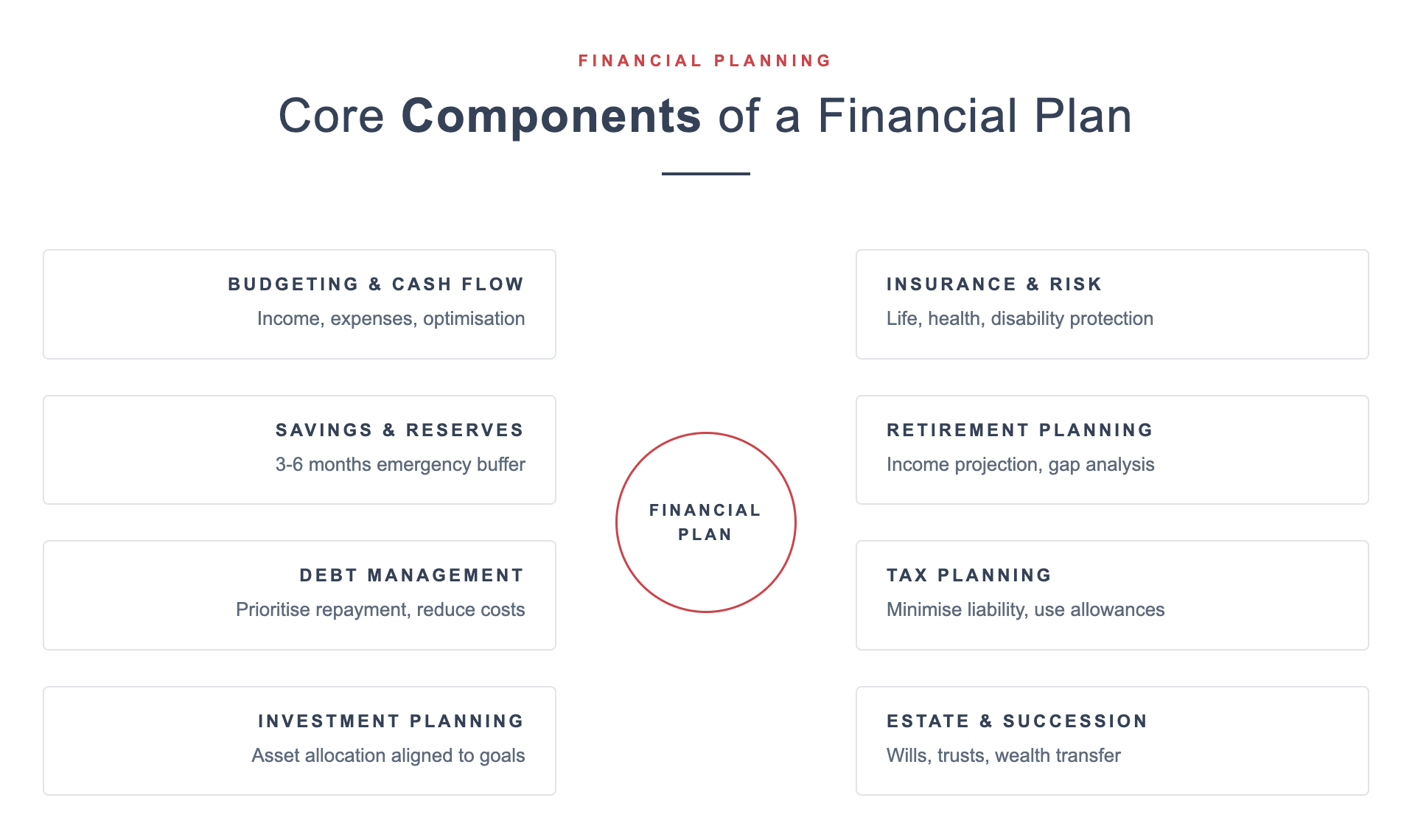
Budgeting and cash flow management - Understanding income and expenses, identifying areas for optimisation, and ensuring positive cash flow to fund savings and investment goals
Savings and emergency reserves - Building a financial buffer (typically 3-6 months of living expenses) to manage unexpected events without disrupting long-term plans
Debt management - Structuring and prioritising debt repayment to minimise interest costs and free up resources for wealth-building
Investment planning - Developing an asset allocation strategy aligned with your goals, risk tolerance, and time horizon. This may include traditional assets, and for some investors, alternative investment funds
Insurance and risk management - Ensuring appropriate protection against key risks: life, health, disability, property, and liability. Term life insurance is one of the most common components of a protection strategy
Retirement planning - Projecting retirement income needs, identifying sources of retirement income, and building a strategy to close any shortfall
Tax planning - Structuring finances to minimise tax liability within legal frameworks, including the use of tax-advantaged accounts, deductions, and timing strategies
Estate and succession planning - Preparing for the transfer of assets to heirs or beneficiaries, including wills, trusts, powers of attorney, and beneficiary designations
Every wealth journey starts with a conversation. Our advisers are ready to understand your objectives, assess your circumstances, and build a strategy tailored to your goals.
The benefits of financial planning extend well beyond investment returns. A well-structured financial plan provides clarity, confidence, and control over your financial life.
Key Benefits
Clarity and Informed Decisions
Clarity on priorities - Financial planning forces you to articulate what matters most. By quantifying goals and ranking priorities, it eliminates ambiguity and provides a clear direction for decision-making.
Informed decision-making - With a plan in place, financial decisions are made in context rather than in isolation. Every choice - from purchasing a property to changing careers - can be evaluated against its impact on the overall strategy.
Risk mitigation - A financial plan identifies potential risks (job loss, health issues, market downturns) and puts safeguards in place before they materialise. This proactive approach reduces financial vulnerability.
Behavioural discipline - One of the most underappreciated benefits of financial planning is its role in managing behaviour. Markets fluctuate, emotions run high, and short-term thinking can derail long-term strategies. A plan provides an anchor - a reference point that encourages consistency and discourages reactive decisions.
Measurable progress - A financial plan creates benchmarks against which progress can be measured. Rather than vague aspirations, it provides specific targets and timelines, making it possible to track whether you are on course.
The OECD’s research consistently shows that individuals with higher financial literacy levels demonstrate better financial behaviours - including saving regularly, planning for retirement, and avoiding excessive debt. Financial planning is both a product of financial literacy and a driver of it.
While many aspects of financial planning can be managed independently, there are situations where professional guidance adds significant value.
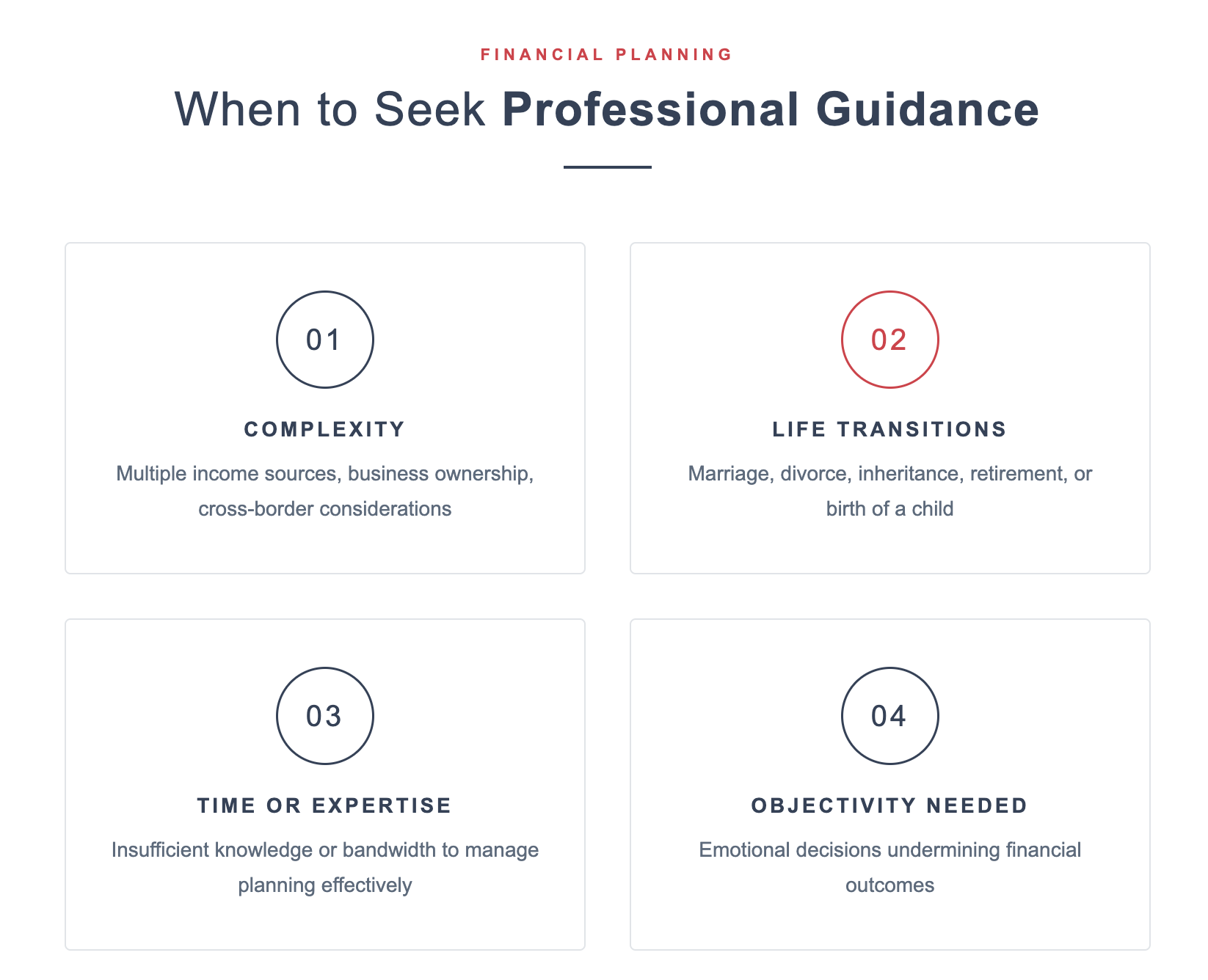
Complexity - When financial circumstances become complex - multiple income sources, business ownership, cross-border considerations, significant assets - a professional can help coordinate and optimise across all areas.
Major life transitions - Marriage, divorce, inheritance, retirement, the birth of a child, or the loss of a spouse are all moments when professional financial guidance can be particularly valuable.
Lack of time or expertise - Financial planning requires knowledge, research, and ongoing attention. A professional can handle the technical work while ensuring the plan stays on track.
Objectivity - Emotional attachment to certain decisions (holding onto a losing investment, overspending on a home) can undermine financial outcomes. A planner provides an objective, external perspective.
When considering professional financial guidance, it is important to understand the distinction between financial planning and wealth management. For those whose needs extend beyond planning into active portfolio management, tax optimisation, and estate strategy, a financial planning and wealth management approach may be more appropriate.

Regulated Advisory
DFSA Regulation in the DIFC
In the DIFC, financial advisory services are regulated by the DFSA, which recorded 902 regulated entities in 2024 - a 14% year-on-year increase, with significant growth in the wealth management sector. Working with a regulated adviser ensures adherence to professional standards, transparency, and client protection.
Our Approach to Your Success
1
Discover You
Understand your situation and define your objectives.
2
Advise You
Create a tailored solution that fits your unique needs.
3
Assist You
Support you through structuring your assets.
4
Accompany You
Build a long-term relationship with regular reviews.
Financial planning is not a theoretical exercise - it is a practical discipline that produces real, measurable outcomes when applied consistently.
In practice, an effective financial plan typically involves:
Annual reviews - A comprehensive check-in to assess progress, adjust for life changes, and rebalance strategies as needed
Scenario analysis - Stress-testing the plan against different outcomes (market downturns, early retirement, unexpected expenses) to ensure resilience
Coordination with other professionals - Working alongside accountants, lawyers, insurance advisers, and investment managers to ensure all elements of the plan are aligned
Documentation - Maintaining clear records of goals, strategies, insurance policies, account details, and estate planning documents
The most effective financial plans share common traits: they are realistic, flexible, well-documented, and regularly reviewed. They do not attempt to predict the future - instead, they prepare for multiple scenarios and create a framework for making sound decisions regardless of what unfolds.
Important Notice
This guide is provided for educational purposes only and does not constitute financial advice. Individuals should consult a qualified professional before making financial decisions.
Hexagone Group — General Disclaimer
Want to build a structured financial plan tailored to your goals and circumstances?
Frequently Asked Questions About Financial Planning
Financial planning is the process of setting financial goals, assessing your current situation, and creating a strategy to achieve those goals. It matters because it provides structure, discipline, and direction - helping individuals make informed decisions, prepare for the unexpected, and work toward long-term financial security.
The process typically involves six steps: understanding your current financial situation, defining goals, analysing the gap between current position and goals, developing recommendations, implementing the plan, and monitoring progress over time. Begin Your Journey With Us.
Financial planning is valuable at every income level. Even with modest resources, a plan can help you budget effectively, build emergency savings, manage debt, and start investing for the future. Professional guidance becomes especially valuable as financial complexity increases.
Most professionals recommend a comprehensive review at least once a year, with additional reviews triggered by major life events such as marriage, the birth of a child, career changes, or inheritance. Contact us for more information.
Investing is one component of financial planning, but financial planning is much broader. It encompasses budgeting, insurance, tax strategy, retirement planning, estate planning, and debt management - all integrated into a single, goal-driven strategy.
Sources
CFP Board — “Guide to the Financial Planning Process” — 2024 — cfp.net