Personal financial planning is the foundation upon which long-term financial security is built. It is the process through which individuals assess their current financial situation, define meaningful goals, and develop a structured strategy to achieve them - taking into account income, expenses, savings, investments, insurance, and future obligations.

Unlike corporate or institutional financial planning, personal financial planning centres on the individual or household. It addresses the questions that matter most to people at every stage of life: Am I saving enough? Am I adequately protected? Will I be able to retire comfortably? How do I manage competing financial priorities?
Personal financial planning is about taking control of your money so that it works toward your goals - rather than simply managing day-to-day expenses and hoping for the best.

Personal financial planning is a systematic approach to managing one’s finances to achieve specific life objectives. It is both a process and a mindset - a commitment to making informed, deliberate decisions rather than reactive ones.
What distinguishes personal financial planning from general financial planning is its action-oriented nature. Financial literacy provides knowledge; personal financial planning applies that knowledge to real decisions with real consequences.
Personal financial planning differs from institutional financial planning in several important ways:
| Criterion | Personal Financial Planning | Institutional Financial Planning |
|---|---|---|
| Scale | Addresses individual or household needs | Addresses organisational objectives |
| Goals | Personal (retirement, education, home ownership, legacy) | Corporate (revenue, shareholder value) |
| Time horizon | Often spans decades, aligning with life stages | Typically shorter, aligned with business cycles |
| Emotional dimension | Deeply connected to values, family dynamics, and life priorities | Rarely applies; driven by data and strategy |
A comprehensive personal financial plan covers seven interconnected areas. Each area requires attention, and neglecting any one of them can undermine progress in the others.

The foundation of any financial plan. Understanding where money comes from and where it goes is essential for identifying opportunities to save, reduce waste, and direct resources toward goals. Effective budgeting is not about restriction - it is about intentional allocation.

An emergency reserve - typically 3-6 months of essential living expenses - provides a buffer against unexpected events such as job loss, medical expenses, or urgent repairs. Without this buffer, individuals are forced to rely on debt or liquidate investments at potentially unfavourable times.

Not all debt is equal. A personal financial plan distinguishes between productive debt (mortgage, education) and unproductive debt (high-interest consumer credit), and creates a prioritised repayment strategy that minimises interest costs and accelerates financial freedom.

Building wealth requires a disciplined approach to saving and a clear investment strategy. Asset allocation - the mix of equities, fixed income, cash, and potentially alternative investments - should reflect your goals, risk tolerance, and time horizon.

Protection against key risks is a non-negotiable element of personal financial planning. This includes life insurance (such as term life insurance), health insurance, disability coverage, and property insurance. The goal is to ensure that an unexpected event does not derail years of financial progress.

Estimating future income needs, identifying retirement income sources (pensions, savings, investments), and building a strategy to close any projected shortfall. The earlier retirement planning begins, the more powerful the effect of compound growth.

Preparing for the orderly transfer of assets to heirs or beneficiaries. This includes wills, trusts, beneficiary designations, and powers of attorney. Estate planning is not only for the wealthy - anyone with dependants or assets benefits from having a clear succession plan.
Creating a personal financial plan does not require advanced expertise - it requires honesty, structure, and commitment. The following framework provides a practical starting point.

Every wealth journey starts with a conversation. Our advisers are ready to understand your objectives, assess your circumstances, and build a strategy tailored to your goals.
Begin Your Journey With UsFinancial priorities evolve as life circumstances change. A personal financial plan should reflect the specific needs and opportunities of each stage.
| Stage | Key Priorities | Primary Focus |
|---|---|---|
| Early career (20s-early 30s) | Build financial habits, start saving, manage student debt | Emergency fund, employer pension/retirement contributions, basic insurance |
| Family building (30s-40s) | Protect dependants, manage growing expenses, plan for education | Life insurance, education savings, mortgage management, increased retirement contributions |
| Peak earning years (40s-50s) | Maximise wealth accumulation, optimise tax efficiency | Diversified investments, tax planning, catch-up retirement contributions, estate planning foundations |
| Pre-retirement (50s-60s) | Consolidate, de-risk, plan transition | Portfolio rebalancing, retirement income strategy, healthcare planning, estate finalisation |
| Retirement (60s+) | Sustain income, preserve wealth, plan legacy | Withdrawal strategy, inflation protection, estate and succession execution |
The key insight is that personal financial planning is not something you do once - it is something you adapt continuously as your life unfolds.
Even well-intentioned individuals make mistakes that can significantly impact long-term financial outcomes. Awareness of these common pitfalls can help you avoid them.
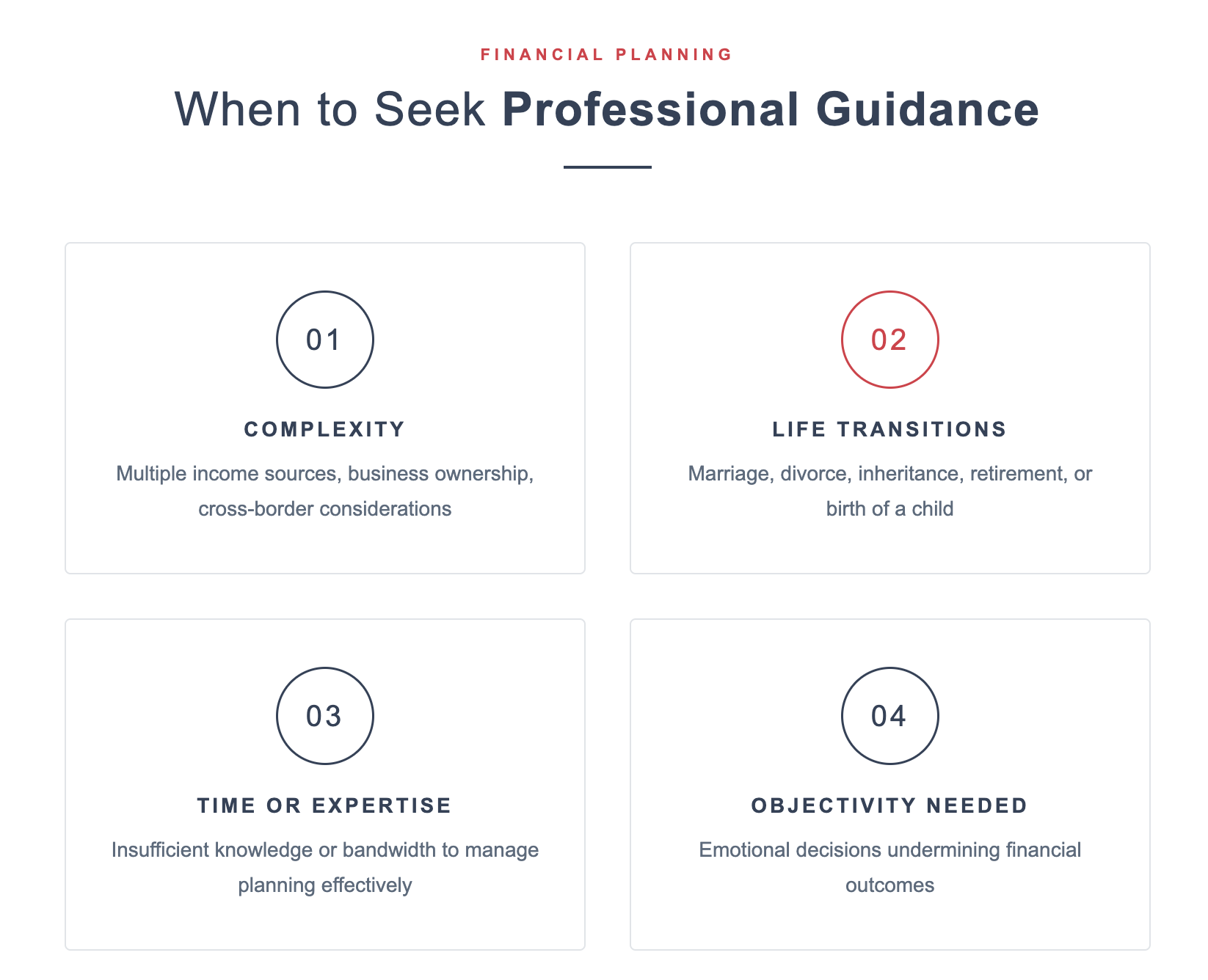
While many elements of personal financial planning can be managed independently, there are situations where professional guidance provides meaningful value.

Multiple income sources, business ownership, cross-border financial obligations, or significant assets often require expertise that goes beyond self-directed planning.

Marriage, divorce, inheritance, the birth of a child, or the death of a spouse create financial implications that benefit from professional analysis and planning.

Structuring finances to minimise tax liability legally requires specialised knowledge, particularly for individuals with complex income streams or international considerations.
Converting accumulated savings into a sustainable retirement income stream is one of the most complex challenges in personal finance. Professional guidance can help navigate withdrawal strategies, tax implications, and longevity risk.
For individuals whose needs extend beyond personal financial planning into comprehensive wealth management - including active investment management, estate structuring, and multi-generational planning - a financial planning and wealth management approach may be more appropriate.

In the DIFC, financial advisory services are regulated by the DFSA, ensuring that advisers meet rigorous standards of competence, transparency, and client protection.
This guide is provided for educational purposes only and does not constitute financial advice. Individuals should consult a qualified professional before making financial decisions.
Hexagone Group — General Disclaimer.jpg)
Personal financial planning is the process of assessing your financial situation, setting individual goals, and creating a structured strategy to achieve them. It covers budgeting, saving, investing, insurance, retirement planning, and estate succession - all tailored to your personal circumstances and priorities.
The seven key areas are: budgeting and cash flow management, emergency fund and financial resilience, debt management, savings and investment planning, insurance and risk management, retirement planning, and estate and succession planning. Begin Your Journey With Us.
Start by gathering all financial information (income, expenses, debts, assets, insurance). Then define clear goals with specific timelines and amounts. Identify the gap between where you are and where you want to be, and build a strategy with specific actions for each goal.
Financial priorities change as life evolves - from building habits in your 20s, to protecting a family in your 30s-40s, to planning retirement in your 50s-60s. A plan that adapts to each stage ensures you are always working toward the most relevant goals. Contact us for more information.
Personal financial planning focuses on creating a strategy for individuals to achieve specific financial goals. Wealth management is a broader, more comprehensive service that includes financial planning plus active investment management, tax optimisation, and estate planning - typically for individuals with higher net worth and more complex needs.


