Private credit has emerged as one of the fastest-growing segments within the alternative investment funds landscape. As traditional banks have retreated from certain lending activities - driven by post-crisis regulation and capital requirements - private credit funds have stepped in to fill the gap, providing loans directly to businesses outside the conventional banking system.
Private credit involves non-bank lenders providing loans directly to companies or projects. Instead of buying publicly traded bonds, investors commit capital to funds that originate, structure, and manage private loans - earning interest income and fees in return.
Private credit - also referred to as private debt - encompasses any non-bank lending activity where loans are originated and held by private fund managers rather than traded on public markets. Unlike publicly traded corporate bonds, private credit instruments are negotiated directly between the lender (the fund) and the borrower (typically a mid-market company).
The key characteristics that distinguish private credit from public fixed income:
| Characteristic | Private Credit | Public Bonds |
|---|---|---|
| Origination | Directly negotiated between lender and borrower | Issued via underwriting, traded on public markets |
| Pricing | Illiquidity premium - typically 150-400 bps above comparable public debt | Market-driven, continuous pricing |
| Customisation | Bespoke covenants, structures, and terms | Standardised terms |
| Liquidity | Illiquid - held to maturity within fund structures | Tradeable on secondary markets |
| Information | Detailed, proprietary due diligence | Public financial disclosures |
| Typical borrower | Mid-market companies ($10M-$500M EBITDA) | Large corporates and governments |
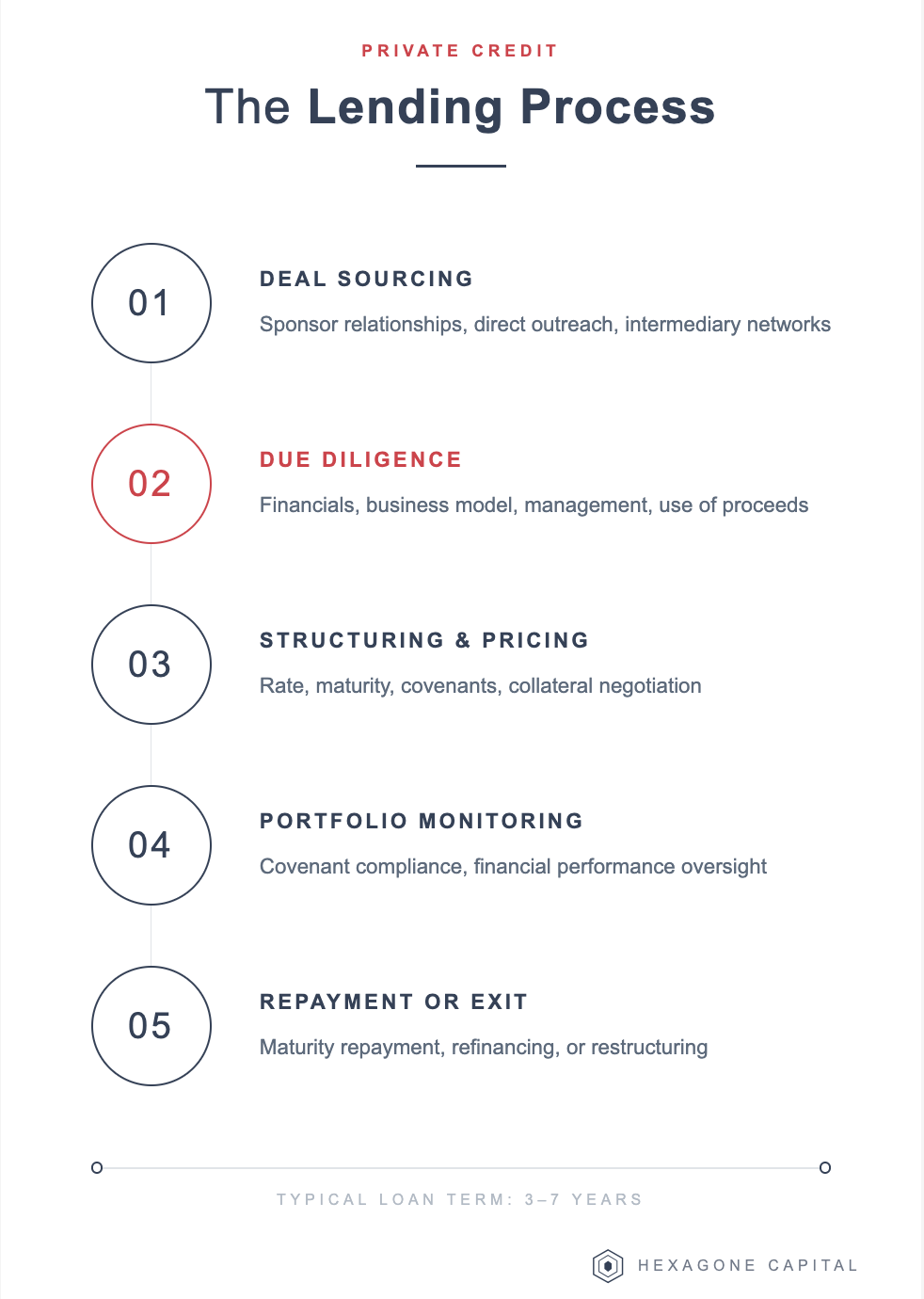
Private credit funds follow a systematic process from deal sourcing to exit:
Private credit funds are typically structured as closed-end vehicles with defined investment periods, similar to private equity. However, the asset class has seen growing innovation in access vehicles:
The private credit universe encompasses a range of strategies with varying risk-return profiles:
| Strategy | Description | Typical Yield Premium | Risk Level |
|---|---|---|---|
| Senior direct lending | First-lien secured loans to mid-market companies | 400-600 bps over base rate | Moderate |
| Unitranche | Blended senior + junior in a single facility | 500-700 bps over base rate | Moderate |
| Mezzanine | Subordinated debt, often with equity warrants | 800-1200 bps + equity kicker | Moderate to high |
| Distressed debt | Purchasing debt of companies in financial difficulty | 15-25% target returns | High |
| Venture debt | Loans to VC-backed companies, often with warrants | 10-15% target returns | High |
| Special situations | Bespoke lending in complex or time-sensitive circumstances | Varies widely | Moderate to high |

Senior direct lending is the largest and most established private credit strategy. Funds provide first-lien secured loans to mid-market companies - often to finance leveraged buyouts, acquisitions, or growth initiatives. These loans sit at the top of the capital structure and are backed by the borrower's assets, providing a degree of downside protection.

Unitranche facilities combine senior and subordinated debt into a single loan with a blended interest rate. This structure simplifies the capital structure for borrowers (one lender, one agreement) while offering investors a yield premium above pure senior lending.

Mezzanine debt occupies a subordinated position in the capital structure - junior to senior debt but senior to equity. Mezzanine lenders accept higher risk in exchange for higher yields and often receive equity warrants that provide upside participation if the borrower performs well.

Distressed debt strategies involve purchasing the debt of companies experiencing financial difficulty, typically at steep discounts. Returns are generated through restructuring, operational turnaround, or recovery of value above the discounted purchase price.
For investors exploring how private credit compares to equity-based alternative strategies with longer operational involvement, private equity offers a complementary perspective focused on direct company ownership and operational value creation.

Every wealth journey starts with a conversation. Our advisers are ready to understand your objectives, assess your circumstances, and build a strategy tailored to your goals.
Begin Your Journey With UsPrivate credit has experienced exceptional growth over the past decade. According to Preqin's Global Private Debt Report (2025), global private credit assets under management have grown from approximately $500 billion in 2015 to over $1.7 trillion in 2024, with projections exceeding $2.5 trillion by 2028.

Post-2008 banking regulations (Basel III, Basel IV) significantly increased capital requirements for bank lending, particularly to mid-market and leveraged borrowers. Private credit funds, unburdened by these requirements, have filled the resulting gap.

In a period of historically low interest rates (2010-2021), institutional investors sought private credit's illiquidity premium as a way to generate meaningful yield above public fixed income.

Many mid-market companies prefer private credit's speed, certainty of execution, and flexibility compared to the syndicated loan or public bond markets.

Pension funds, insurance companies, and sovereign wealth funds have steadily increased their allocations to private credit, attracted by the yield premium and diversification benefits.
Private credit serves a distinct role within a multi-asset portfolio, offering characteristics that differ from both public fixed income and equity alternatives:
| Criterion | Private Credit | Investment-Grade Bonds | High-Yield Bonds |
|---|---|---|---|
| Typical yield | Base rate + 400-700 bps | Base rate + 80-150 bps | Base rate + 300-500 bps |
| Liquidity | Illiquid (3-7 year terms) | Daily secondary market | Daily secondary market |
| Rate type | Predominantly floating | Predominantly fixed | Mixed |
| Covenants | Maintenance covenants (strong lender protection) | Incurrence covenants (weaker) | Incurrence covenants (weaker) |
| Recovery rates | Historically 60-70% (first lien) | Varies by seniority | Historically 40-50% |
| Minimum investment | $100K-$5M (fund dependent) | $1,000-$10,000 | $1,000-$10,000 |
Investors should carefully evaluate several categories of risk:
This guide provides general information only and does not constitute financial advice. Individual circumstances, risk tolerance, and investment objectives should always be discussed with a qualified adviser.
.jpg)
Rigorous due diligence is critical given the illiquid, opaque nature of private credit. Key evaluation areas:
For investors exploring how alternative credit strategies interact with broader multi-strategy approaches and tactical asset allocation, hedge fund strategies offer perspectives on credit-focused trading and event-driven investing.
Private credit involves non-bank lenders providing loans directly to companies outside the traditional banking system. Investors earn interest income and fees from these loans, which are typically held to maturity within fund structures rather than traded on public markets.
Investors can access private credit through closed-end funds, evergreen vehicles, BDCs (in the US), and co-investment opportunities. Minimum investments vary from $100,000 to several million depending on the vehicle. To explore options suited to your profile, begin your journey with us.
Senior direct lending strategies typically target yields of 8-12% (base rate + 400-600 bps), while mezzanine and distressed strategies may target higher returns. Actual performance depends on the interest rate environment, credit conditions, and manager quality.
Private credit provides debt financing to companies and generates returns primarily through interest income. Private equity takes ownership stakes and generates returns through operational value creation and equity appreciation. Private credit typically offers lower returns with lower risk and shorter durations. Contact us for more information about how these strategies complement each other.
Key risks include borrower default, illiquidity (capital locked for 3-7 years), valuation subjectivity, fund-level leverage, concentration risk, and potential covenant erosion in competitive lending markets. Thorough due diligence on the manager's track record across credit cycles is essential.


